AI Is Already Reshaping L&D From The Backside Up
AI in L&D has crossed from experiment to expectation. 87% of groups already use it, and solely 2% haven’t any adoption plans. For those who wait, you may fall behind.
On this article, I will present the proof of this tipping level, what it means on your staff, and the strikes to make now. So you’ll be able to scale with confidence.
About The Analysis
The insights on this article come from the AI in Learning & Development Report 2026, a worldwide research carried out by Synthesia in partnership with Dr. Philippa Hardman. The analysis gathered 421 responses from L&D leaders, Educational Designers, studying technologists, HR and expertise groups, and Topic Matter Specialists throughout North America, Europe, APAC, LATAM, and MEA.
Members represented a variety of industries—expertise, schooling, consulting, manufacturing, healthcare, finance, authorities, and extra—with a powerful enterprise skew: practically half work in organizations with 1000+ workers.
The Numbers Do not Lie: AI Adoption In L&D Is Now Mainstream, However Not From The Common Sources
With 87% of L&D groups actively utilizing AI, we have moved from “ought to we?” to “how briskly can we scale?” In accordance with the analysis, 57% of groups are actively utilizing AI in manufacturing, whereas one other 30% are working pilots. Examine that to final yr, when 20% of organizations weren’t utilizing AI in any respect. Now solely 2% haven’t any adoption plans.
“Is your L&D staff presently utilizing AI instruments in your Studying and Improvement packages?”
I’ve watched this shift occur firsthand. A yr in the past, groups would quietly check ChatGPT for course outlines. A lot of the AI adoption was occurring bottom-up and never aligned to a proper organizational technique. Now those self same groups have shared AI playbooks and staff workflows.
The drivers are clear: value and time financial savings, sooner manufacturing, and effectivity.
A studying staff inside a worldwide pharmaceutical producer started with zero AI functionality and relied solely on guide processes for goals, eventualities, and assessments. Inside six months, they constructed a documented library of prompts and workflows that standardized how AI supported each stage of their design course of. The breakthrough got here once they stopped treating AI as a content material shortcut and rebuilt their workflows round readability, templates, and quality control. The shift minimize improvement cycles in half and diminished rework as a result of groups lastly had a shared methodology for producing constant outputs. That is crucial to get proper: the transformation did not come from experimenting with instruments however from institutionalizing repeatable AI practices that scaled throughout the group.
Whereas executives debate governance, groups already use AI to generate quiz questions (60%) and text-to-speech narration (63%) at scale. This bottom-up adoption modifications the way you method AI technique. It additionally exhibits up in admin work: groups lean on AI to draft experiences, insurance policies, and inner communications that used to eat total afternoons.
What it is best to do now:
- Share these adoption statistics with govt sponsors to safe finances.
- Create a proper staff AI playbook documenting present use circumstances and workflows.
- Set a 90-day scaling goal to broaden pilots into outlined, team-level workflows.
From Sooner Content material To Smarter Studying: How AI Use Has Developed
Early AI studying use circumstances centered on pace of content material technology: creating quizzes, drafting scripts, translating content material. Time saved nonetheless issues to 88% of groups. Nevertheless it’s not the one story.
Groups are transferring to adaptive pathways, expertise mapping, and AI tutors—options geared toward bettering learner expertise, not simply pace.
A big consumer-services firm was fighting uneven capabilities throughout its customer-facing groups however lacked the bandwidth to create focused coaching on the tempo operations required. The shift occurred once they moved from counting on text-based coaching paperwork to utilizing AI to generate training videos, guides, eventualities, and refreshers tied on to the ability gaps supervisors had been seeing in actual time. Managers may refine these AI videos in minutes, making steady upskilling possible with out pulling individuals off the ground. Efficiency turned extra constant throughout areas with no added headcount. That is crucial to get proper: the true leverage got here from accelerating content material creation to satisfy rising gaps, not from refined automation.
The subsequent frontier is that groups now analyze wants with AI, design adaptive sequences, implement tutors, and consider with predictive analytics. Whereas 88% worth time financial savings right now, 72% count on personalised studying to develop into the first profit.
What it is best to do now:
- Choose two or three use circumstances past content material manufacturing: assessments or simulations, adaptive pathways, or AI tutors.
- Create or floor analysis rubrics which are designed round altering outcomes like lowering error charge or time-to-competency.
- Outline success metrics upfront so you’ll be able to show worth past time saved.
The L&D Skilled’s New Actuality: Strategic Architect, Not Content material Creator
The intent of recent L&D has shifted: the position is not to push out programs, however to architect workforce functionality, aligning expertise, programs, and communication to enterprise priorities.
In observe, most groups nonetheless spend the majority of their time on manufacturing duties: fixing slides, drafting scripts, rewriting SME content material, managing revisions, and dealing with infinite admin that absorbs total weeks.
That is the hole that issues: whereas the intent is strategic, the day-to-day actuality is executional, reactive, and dominated by low-leverage work. AI now handles routine duties like draft scripting, translation, and fundamental assessments. That frees L&D to concentrate on functionality constructing and studying structure.
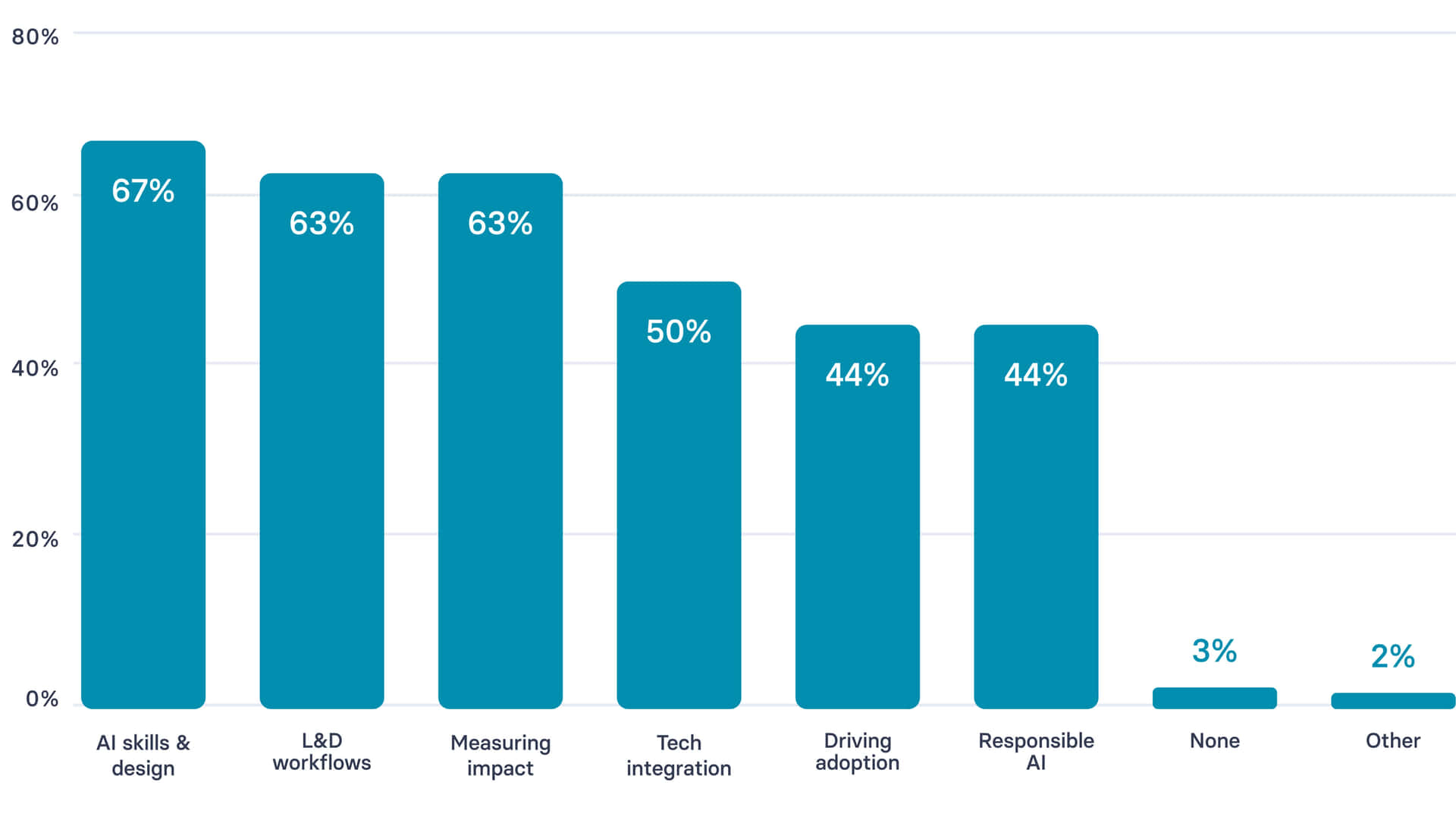
Nevertheless it requires new expertise. For instance, 67% of L&D professionals need AI expertise coaching for his or her groups, and 63% want steering on integrating AI into workflows.
“What forms of coaching or assist would assist your staff use AI extra successfully in L&D?”
Efficient L&D groups are extra like efficiency consultants, not course builders. They join enterprise technique to workforce functionality, spot ability gaps early, and measure affect in outcomes, not completions.
On the bottom, AI additionally takes the admin load: drafting stakeholder updates, SOPs, and coverage refreshes so the staff can keep targeted on design and alter administration.
Human judgment stays important. AI can generate content material, however individuals guarantee it suits tradition, context, and conduct change targets.
What it is best to do now:
- Map staff roles to new ability wants: AI literacy, information fluency, moral implementation, and programs pondering.
- Ship at the least 5 hours of role-specific AI coaching for every staff member.
- Set up an inner AI group of observe to share prompts, workflows, and high quality requirements.
The Coaching Multiplier Impact: Your Secret Weapon For AI Adoption
AI adoption would not rise as a result of groups get entry to a instrument; it rises as a result of groups obtain small, focused bursts of coaching tied on to their work. The sample is constant: when groups study the fundamentals, unfold greatest practices (and workflows) after which instantly apply them to actual tasks, utilization climbs.
In my expertise, the coaching that works is light-weight, utilized, and role-specific. Skip the generic prompts and share how particular prompts and workflows can enhance the work that is already being executed, inside the programs groups already use.
What it is best to do now:
- Provide quick, sensible recommendations targeted on actual work and duties.
- Construct a small set of shared prompts and templates tied to core workflows.
- Monitor a easy earlier than/after metric: “How lengthy did this process take final month vs. this month with the brand new workflow?”
- Frequently revisit these workflows.
Measure What Issues: Shift From Pace To Outcomes (Or New Behaviors)
Groups are transferring from time saved (right now’s 88%) to enterprise affect (55% anticipated) and personalization (72% anticipated), but 63% need assistance measuring affect.
Most groups can quantify hours saved. Fewer can join AI to outcomes. However in case you begin along with your identified data, you can begin to make a case.
A coaching staff I labored with within the communications sector diminished onboarding time, however we could not instantly tie that discount to enterprise outcomes. Utilizing a easy ROI mannequin, we traced the discount in ramp time again to onerous numbers:
- New rent wage
- Price of growing coaching content material
- Supervision value per new rent
- Anticipated ramp time for brand spanking new rent
Onboarding dropped from 26 weeks to 7 after implementing new AI-enabled content material and workflows.
That is crucial to get proper: enterprise leaders do not care that onboarding is “sooner.” They care that sooner onboarding reduces the price of paying a brand new rent to be educated; that it frees up supervisor capability, and accelerates time-to-productivity. Linking these outcomes to particular AI workflows is the true worth.
Groups that succeed set up baselines, decide metrics enterprise leaders care about, and report persistently.
What it is best to do now:
- Select one program to instrument end-to-end.
- Select a KPI that you may hyperlink AI inputs to enterprise outcomes.
- Run a 90-day experiment and share outcomes with stakeholders to start out constructing your case.
The Agentic Future Is Already Right here (And L&D Groups Are Constructing It)
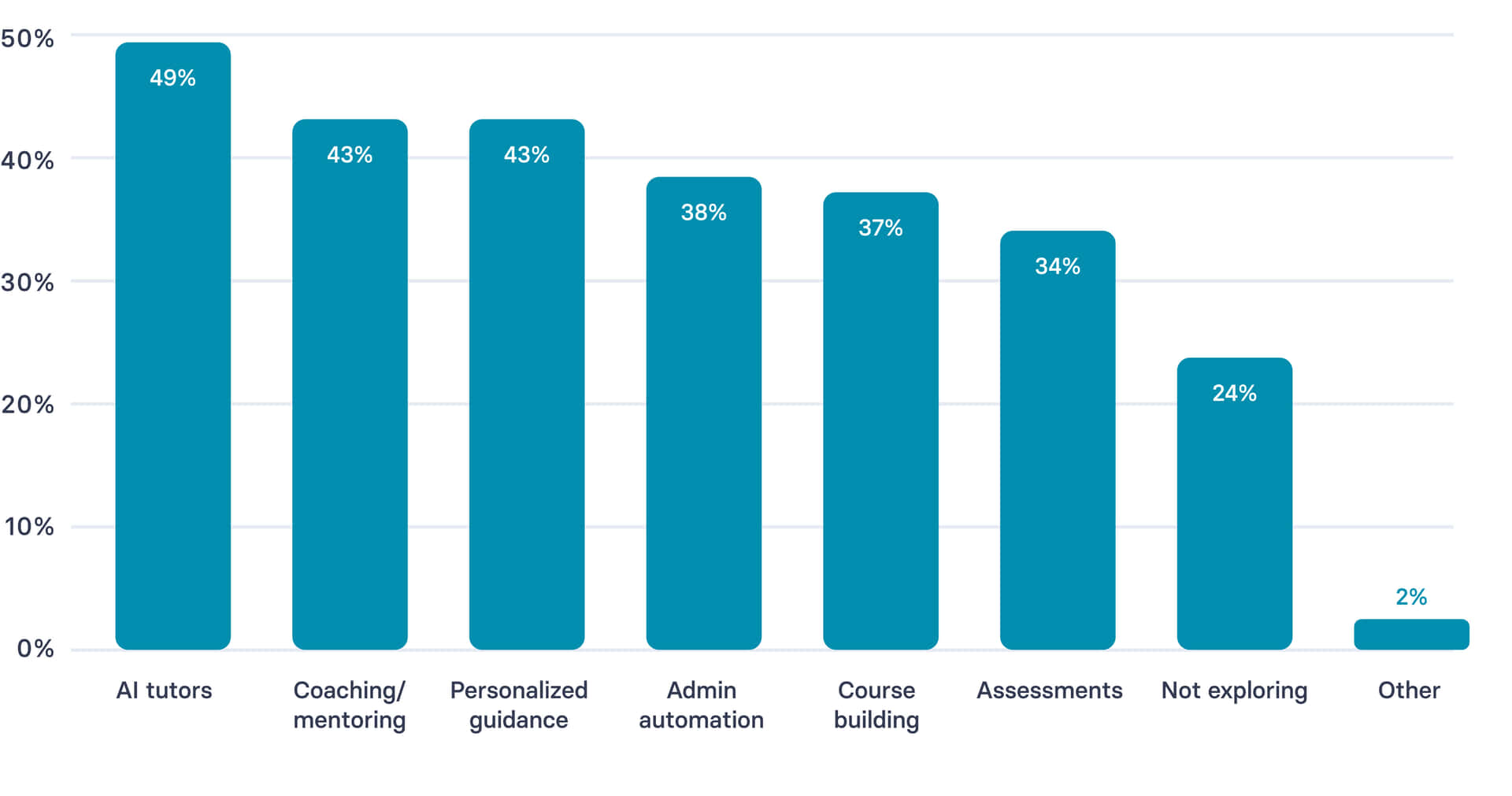
With 49% exploring AI tutors and 43% investigating AI-powered teaching, groups are constructing autonomous studying programs now.
“Which of the next agentic capabilities are you exploring in your L&D work?”
What Is Agentic AI?
Agentic AI, in L&D phrases, refers to AI programs that take goal-driven actions: they information learners, make choices, and adapt interventions with out fixed human prompting.
Consider an AI tutor that detects a learner’s battle, adjusts issue, recommends sources, and schedules a follow-up evaluation.
I am seeing this within the subject. An eCommerce furnishings retailer makes use of an AI coach to investigate agent efficiency and coach to particular behaviors. A healthcare firm constructed an AI FAQ agent that solutions technical questions, suggests options, and routes complicated queries to human specialists.
The place ought to these brokers stay? 27% of L&D professionals do not know, and opinions break up throughout LMS, productiveness instruments, standalone apps, and integration layers. Solely 47% consider the LMS will stay the spine.
Additionally, integration is tough. 50% of groups want technical assist to attach AI instruments to present programs, notably when questions are raised by an IT council.
What it is best to do now:
- Pilot one agentic use case in a low-risk space like onboarding or product data.
- Design guardrails into agent directions as a primary or second step.
- Flag IT considerations early and sometimes earlier than continuing with pilots.
Ultimate Ideas
The tipping level is not coming. It is right here.
AI is already reshaping L&D from the underside up, and the groups that transfer quickest aren’t those with the most important budgets or probably the most mature methods. They’re those who concentrate on three issues: constructing small however significant expertise, rewriting workflows the place AI creates actual leverage, and measuring outcomes leaders truly care about.
That is crucial to get proper: the worth of AI in L&D is not going to be decided by what number of instruments you deploy, however by how successfully you scale back friction within the work, speed up functionality constructing, and exhibit affect by way of efficiency, high quality, or speed-to-productivity. The shift is already underway: from content material manufacturing to functionality design, from exercise metrics to enterprise outcomes, from experimentation to scalable observe.
The groups that win now are those that:
- Put money into light-weight, role-relevant AI expertise—not massive coaching packages.
- Construct clear, repeatable workflows the place AI handles the low-leverage work.
- Anchor each use case to a enterprise metric that issues.
- Pilot small, instrumented experiments and scale solely what proves worth.
Begin with one high-impact workflow. Show the end result. Increase intentionally.
That is how L&D strikes from experimenting with AI to reshaping how the group learns, performs, and adapts.

Synthesia
Synthesia is the enterprise AI video platform for L&D and Communications groups. Create, translate, and replace coaching movies in minutes with studio‑high quality avatars, correct lip‑sync, and governance controls constructed for international organisations.
Trending Merchandise