A criminal offense scene sketch holds an unlimited quantity of data, making it an essential a part of any police investigation. Whenever you deliver against the law scene sketch right into a forensic science lesson, that data turns into a invaluable educating software—one which’s certain to curiosity even essentially the most reluctant highschool science college students.
Add sketch-the-scene forensic science actions, classes, and assets to your crime scene unit to assist college students apply following instructions and making use of sensible math and remark expertise. Your true crime unit will likely be memorable and academic!
True Crime Sketch-the-Scene Forensic Science Actions
True crime is a well-liked film, tv, and podcast style for a motive. Individuals are within the crime itself, however greater than that, they’re intrigued by the way in which the forensic workforce works collectively to resolve the crime rapidly. Add a component of true crime to your STEM activities for high school, together with sketch-the-scene forensic science actions, to point out college students how essential proof and particulars will be in police investigations.
- Crime Scene Investigators: Have college students study to sketch crime scenes as a part of a unit on career exploration for high school students, and have them analysis extra in regards to the position of forensic scientists and crime scene investigators.
- Fictional Crime Podcast: Utilizing true crime podcasts as inspiration, college students can create a fictional crime occasion and plan a podcast episode (or sequence of episodes) that makes use of against the law scene sketch to resolve the case.
- True Crime Analysis Venture: Encourage teams or people to analysis a real crime occasion and report on the case process to the category, together with an correct and analyzed crime scene sketch.
💡Professional Tip: “True crime is a good way to pique college students’ curiosity and get them extra engaged in against the law scene sketching lesson plan. There are many documentaries on the market, and college students taking your forensics class are most likely already watching them. Omit the blood and gore, however incorporating related forms of proof or themes for the kind of crime, even the names of suspects and victims, can information you to an acceptable utilization of those true crimes.”
— Linda M., NYS Grasp Trainer Emeritus, from Small Town Science
Map out a real crime scene sketch
It’s one factor to map out a fictional crime scene, however what do actual crime scenes seem like? Train college students to map out against the law scene sketch from a real crime occasion that they’ve researched and analyzed themselves.
Crime Scene Sketch Assignment
By Life in Prism
Grades: Ninth-Twelfth
Topics: Legal Justice, Legislation, Forensics
People and teams use forensic science sketch-the-scene expertise to analysis a real crime occasion and map out the crime scene accordingly, utilizing measurement parameters and particulars from case research.
Following Instructions in Crime Scene Sketch Actions
Crime scene sketches assist college students apply following instructions, particularly on the subject of scientific procedures. Many features of forensic science are aligned to NGSS, together with Science and Engineering Practices and Crosscutting Ideas, and every ability emphasizes the significance of following instructions exactly. Use these sketch-the-scene forensic science actions to show college students tips on how to comply with procedural steps.
- Logic Puzzles: Assign crime-related grid logic puzzles for college kids to apply narrowing down choices, following instructions, and drawing inferences.
- Companion Instructions: Have pairs take turns studying one another instructions for against the law scene sketch, and see how nicely they did with solely verbal directions for every sketch.
- Crime Scene Classroom: See how nicely college students can comply with instructions by organising against the law scene with offered supplies, measurement instruments, and little or no instructor intervention.
Sketch the crime scene by following instructions
How nicely can your college students comply with written instructions? Incorporate this invaluable ability in an upcoming science lesson or when educating college students about sketching crime scenes in a forensic science unit.
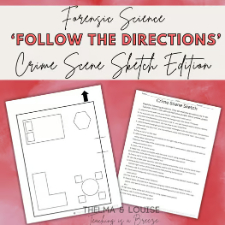
CSI Forensic Science: Follow the Directions – Crime Scene Sketch Edition
By Thelma and Louise – Instructing is a Breeze
Grades: Sixth-Twelfth
Topics: Legal Justice, Legislation, Forensics
A lot of forensic science—and all science, for that matter—entails following instructions. Take college students by way of the mandatory steps for sketching against the law scene in a forensic science lesson that leads people or teams by way of particular and detailed directions, and contains scholar notes, instructor notes, and a clean crime scene printable.
Math and Measurement Forensic Science Concepts
Forensic scientists use arithmetic each day, from measuring the weather of their crime scene to calculating the outcomes of the proof they acquire. Use these sketch-the-scene forensic science actions as interdisciplinary alternatives to mix math and science in partaking methods.
- Blood Spatter Evaluation: College students use geometry and trigonometry expertise to decipher how against the law occurred primarily based on blood spatter proof in against the law scene.
- Scale Sketches Up: Utilizing their algebraic and arithmetic expertise, college students take a sketch and scale it as much as both a posterboard measurement or a complete classroom crime scene reconstruction.
- Polar Coordinate Mapping: Have teams triangulate their crime scene sketches with polar coordinates by establishing a reference level and measuring distance and angle to essential proof.
💡Professional Tip: “College students wrestle with taking measurements and creating an acceptable scale to make use of for his or her formal drawing. I work one-on-one with small teams to take measurements of the crime scene. I attempt to maintain the scene small and comparatively rectangular with few objects/items of proof within the scene. All measurements are recorded in a knowledge desk for that group to make use of. I discover that with measurement and proportionality, college students get a greater understanding after they have had firsthand expertise in seeing the scene in actual life and on paper. They’ll visualize the connection.”
— Linda M., NYS Grasp Trainer Emeritus, from Small Town Science
Take a measured method to crime scene investigation
Present college students that they actually will use all that measurement information someday with a math-centered lesson in forensic science. These sensible functions of arithmetic, algebra, geometry, and trigonometry can illuminate every idea in a brand new and engaging approach.
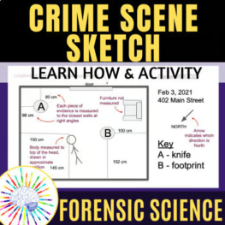
Forensic Science: Teach how to Sketch a Crime Scene
By Science of Curiosity
Grades: Ninth-Twelfth
Topics: Forensics, Science
Scaffold an interdisciplinary crime scene sketching lesson with components of mathematical measurement and forensic science. College students work by way of one step-by-step crime scene sketching exercise with digital measurement instruments earlier than creating their very own crime scenes primarily based on what they’ve realized.
Triangulate the crime scene
One of many first issues crime scene investigators do with against the law scene sketch is to triangulate it between two reference factors and a chunk of proof. Present college students tips on how to carry out this simple and essential activity with the mathematics expertise they’re studying now, together with thought-provoking crime scene sketch classes.
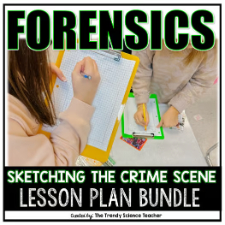
Sketching the Crime Scene: Lesson Plan Bundle
By The Stylish Science Trainer
Grades: Eighth-Twelfth
Topics: Legal Justice, Legislation, Forensics, Science
A lesson plan, editable choice notes, apply worksheet, and sketching exercise take college students by way of the essential steps of sketching and triangulating against the law scene the way in which forensic scientists do.
Compelling Crime Scene Actions for Artwork Class
Forensic science doesn’t simply belong in science and math lessons. Enable artwork college students to hone their expertise whereas training the various kinds of crime scenes, together with tough sketches, completed sketches, overview and fowl’s eye sketches, and exploited view sketches.
- Consideration to Element: Encourage artwork college students to take extra primary crime scene directions and add inventive particulars, similar to shading and perspective.
- Tough to Polished: Apply the artwork of fast sketches by giving artwork college students a restricted time to create their tough draft, whereas nonetheless offering sufficient context to make a later polished draft attainable.
- Composite Sketches: Given the element they uncover and analyze in an interdisciplinary crime scene lesson, similar to a suspect’s top and witness accounts, have college students take turns taking part in “witness” (the particular person describing the topic) and the artist following their directions.
Suggestions for Instructing Forensic Science
Observe these tricks to arrange the strongest forensic science unit attainable, together with sensible crime scene setups and sketch-the-scene classes.
- Embrace a wide range of science expertise that connect with National Institute of Standards and Technology forensic science requirements, similar to hint proof classes in chemistry or sample interpretation in physics.
- Frontload the instruction earlier than having against the law scene day, and attempt to maintain the day itself largely student-led. They need to apply making their very own inferences slightly than filling within the blanks.
- Usher in specialists to speak in regards to the methods they use these expertise each day, together with forensic scientists or crime scene investigators.
- Concentrate on the crime scene evaluation slightly than the violence of the crime. Most high-school stage forensic science classes cut back the quantity of violence within the description or photos, so that they depend on these supplies.
- Have obligatory instruments available, similar to magnifying glasses, dusting powder, microscopes, and something you want for various kinds of proof.
- Get entangled together with your faculty’s mock trial workforce as a joint mission in your younger scientists to research and report back to the workforce as proof.
💡Professional Tip: “Because the instructor, you assist to deliver the joy, but in addition act as a information. I wish to be part of the method simply as a lot as they do! Planning can be key. I have to assume by way of all supplies, the time it’ll take, and any attainable obstacles we might encounter, earlier than we even leap into the project. Do I want to order a room or location for against the law scene? Do I have to notify the administration or put up indicators for the janitorial employees to verify the scene doesn’t get disturbed?”
— Linda M., NYS Grasp Trainer Emeritus, from Small Town Science
Apply inquiry-based studying with forensic science
Crime scene evaluation is a sensible and interesting approach for college kids to use the science, math, and inventive expertise they’ve realized in school. Whether or not they’re engaged on sketch-the-scene forensic science actions or developing a real-life crime scene within the classroom, they’ll comply with their very own curiosity to resolve the crime (which is a superb technique to apply inquiry-based learning in any highschool classroom).
Use these exercise concepts and extra high school forensic science resources to get college students pondering, working, and studying. They could even start pursuing a profession alternative they’d by no means thought-about earlier than!
Trending Merchandise