Mixing Reasoning With Quick Studying
Neuro-symbolic Synthetic Intelligence (NSAI) denotes a analysis paradigm and technological framework that synthesizes the capabilities of up to date Machine Studying, most notably Deep Studying, with the representational and inferential strengths of symbolic AI. By integrating data-driven statistical studying with specific information constructions and logical reasoning, NSAI seeks to beat the constraints inherent in both method when utilized in isolation.
Symbolic: Logic, Ontologies. Neural Networks: Construction, Weights.
Inside this paradigm, the time period “symbolic” refers to computational methodologies grounded within the specific encoding of information by way of formal languages, logical predicates, ontologies, and rule-based techniques. Such symbolic representations, starting from mathematical expressions and logical assertions to programming constructs, allow machines to control discrete symbols, implement constraints, and derive conclusions by way of structured inference. Symbolic AI thus emphasizes the classification of entities and the articulation of their relationships inside machine-readable information frameworks that assist clear, logically grounded reasoning processes.
In purely sub-symbolic neural networks, info is captured implicitly by way of patterns of weighted connections which might be steadily adjusted throughout coaching. These distributed representations permit the community to approximate desired outputs with out counting on specific, human-interpretable constructions. Though such fashions excel at extracting correlations from unstructured knowledge and supply exceptional scalability in dynamic, data-rich environments, their limitations have change into more and more evident. Sub-symbolic techniques usually battle to generalize past their coaching distribution, significantly when confronted with novel or complicated patterns. This may manifest in misguided or fabricated outputs, generally termed hallucinations, in addition to uncontrolled biases and a persistent lack of clear justification for the conclusions they generate.
The mixing of the structured reasoning capabilities of symbolic techniques (reminiscent of specific relationships, constraints, and formal logic) with the pattern-learning strengths of neural networks varieties the inspiration of NSAI (illustrated in Determine 1). This hybrid prototype leverages each paradigms: neural fashions extract options from unstructured knowledge (quick studying), whereas symbolic representations present context, construction, and interpretability (reasoning).
Determine 1. NSAI: a symbiosis between Neural Networks and Symbolic Techniques
An Software Area And Taxonomy
In medical diagnostics, for instance, a deep-learning classifier might detect visible patterns in an imaging scan and assign a probabilistic label for a specific illness, but supply no rationale for its conclusion. By incorporating area information, reminiscent of ontologies of medical situations, causal relationships between signs, and structured scientific pointers, a neuro-symbolic system can contextualize the picture options inside a broader medical framework. Such enriched illustration helps extra correct diagnostic reasoning, permits cross-referencing with affected person histories and statistical well being knowledge, and in the end yields predictions which might be each extra dependable and extra explainable to clinicians.
Latest literature has launched a number of taxonomies for neuro-symbolic AI. Right here, we reference one particular taxonomy [1] , which organizes NSAI techniques into three important classes:
- Studying for reasoning
Neural networks and Deep Studying fashions are used to extract symbolic information from unstructured knowledge, reminiscent of textual content, pictures, or video. The extracted information is then built-in into symbolic reasoning or decision-making processes. - Reasoning for studying
Symbolic information, reminiscent of logic guidelines, semantic constructions, or area ontologies, is integrated into the coaching of neural fashions. The method improves generalization, efficiency, and interpretability. In knowledge-transfer eventualities, symbolic info guides studying when adapting fashions throughout domains. - Studying–reasoning (bidirectional integration)
Neural and symbolic elements work together frequently. Neural networks generate hypotheses or predictions about relationships and guidelines, whereas the symbolic system performs logical reasoning on this info. The symbolic outcomes are then fed again to the neural community, refining and bettering the general system’s efficiency.
Previous, Current, Future
Though the foundations of neuro-symbolic AI have been laid many years in the past, the sphere has gained exceptional momentum solely lately, as demonstrated by a surge in scholarly work. Rising curiosity is pushed by its potential in high-impact domains: in healthcare, NSAI can mine scientific literature and mix affected person knowledge with structured medical information to assist extra knowledgeable reasoning; in robotics, it presents a pathway to extra perceptive, adaptable, and autonomous techniques by merging discovered representations with specific logic-based resolution processes. Monetary markets might also profit from NSAI by bettering credit score danger prediction [2] by way of combining data-driven studying with structured monetary information.
Regardless of this progress, NSAI has but to attain substantial business adoption. Even in Pure Language Processing, an space with clear potential for symbolic integration, present techniques stay largely neural and barely incorporate specific symbolic reasoning. A central problem stays mix neural and symbolic elements in ways in which protect the strengths of each. Attaining this requires new architectures and studying paradigms able to unifying statistical sample recognition with structured reasoning. Though important advances exist, a broadly efficient and scalable integration technique has not but been established.
Symbolic elements additionally face effectivity limitations. Developing logic guidelines and structured information usually depends on labor-intensive, expert-driven processes. Neural networks are subsequently usually used to handle duties which might be computationally prohibitive for purely symbolic techniques. Automating rule extraction and creating extra sturdy symbolic-representation studying strategies characterize necessary future analysis instructions.
The way forward for NSAI is carefully tied to developments in neural networks, whose capabilities and limitations each inspire and constrain NSAI approaches. Latest progress in Giant Language Fashions (LLMs) is very noteworthy, as these techniques more and more display proficiency in mathematical and logical duties historically related to symbolic AI. Determine 2 compares a number of main AI system classes, reflecting their present ranges of business adoption, analysis curiosity, and explainability (outlined right here because the extent to which a mannequin’s inside processes or outputs may be clearly understood).
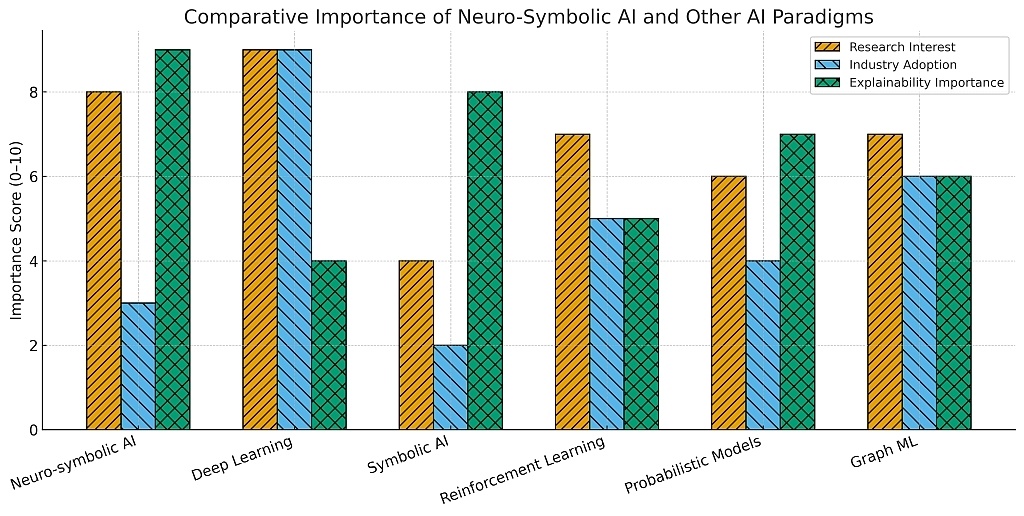
Determine 2. Neuro-Symbolic AI vs. main AI system classes
Whether or not NSAI represents the following essential paradigm in Synthetic Intelligence stays an open debate. After all, this dialogue is intertwined with broader questions on how carefully AI ought to mimic the human mind. Neural networks summary organic constructions, whereas symbolic techniques replicate the express reasoning patterns people articulate. Understanding how these two views relate, and whether or not they can meaningfully complement each other, lies on the coronary heart of NSAI’s promise and its ongoing inquiry.
References:
[1] D. Yu, B. Yang, D. Liu, H. Wang, S. Pan. “A survey on neural-symbolic studying techniques”, in Neural Networks, Vol. 166, 2023, p. 105-126, ISSN 0893-6080, https://doi.org/10.1016/j.neunet.2023.06.028
[2] V. Dey, F. Hamza-Lup and I. E. Iacob. “Leveraging Prime-Mannequin Choice in Ensemble Neural Networks for Improved Credit score Threat Prediction”, 17 Intl. Conf. on Electronics, Computer systems and Synthetic Intelligence (ECAI), Targoviste, Romania, pp. 1-7, https://doi.org/10.1109/ECAI65401.2025.11095568
Picture Credit:
- The pictures inside the physique of the article have been created/equipped by the writer.
Trending Merchandise