by Terry Heick
Humility is an attention-grabbing start line for studying.
In an period of media that’s digital, social, chopped up, and endlessly recirculated, the problem is not entry however the high quality of entry—and the reflex to then choose uncertainty and “reality.”
Discernment.
On ‘Figuring out’
There’s a tempting and warped sense of “realizing” that may result in a lack of reverence and even entitlement to “know issues.” If nothing else, fashionable expertise entry (in a lot of the world) has changed subtlety with spectacle, and course of with entry.
A thoughts that’s correctly observant can be correctly humble. In A Native Hill, Wendell Berry factors to humility and limits. Standing within the face of all that’s unknown can both be overwhelming—or illuminating. How wouldn’t it change the educational course of to begin with a tone of humility?
Humility is the core of crucial considering. It says, ‘I don’t know sufficient to have an knowledgeable opinion’ or ‘Let’s study to cut back uncertainty.’
To be self-aware in your personal information, and the boundaries of that information? To make clear what may be identified, and what can’t? To have the ability to match your understanding with an genuine must know—work that naturally strengthens critical thinking and sustained inquiry.
What This Appears Like In a Classroom
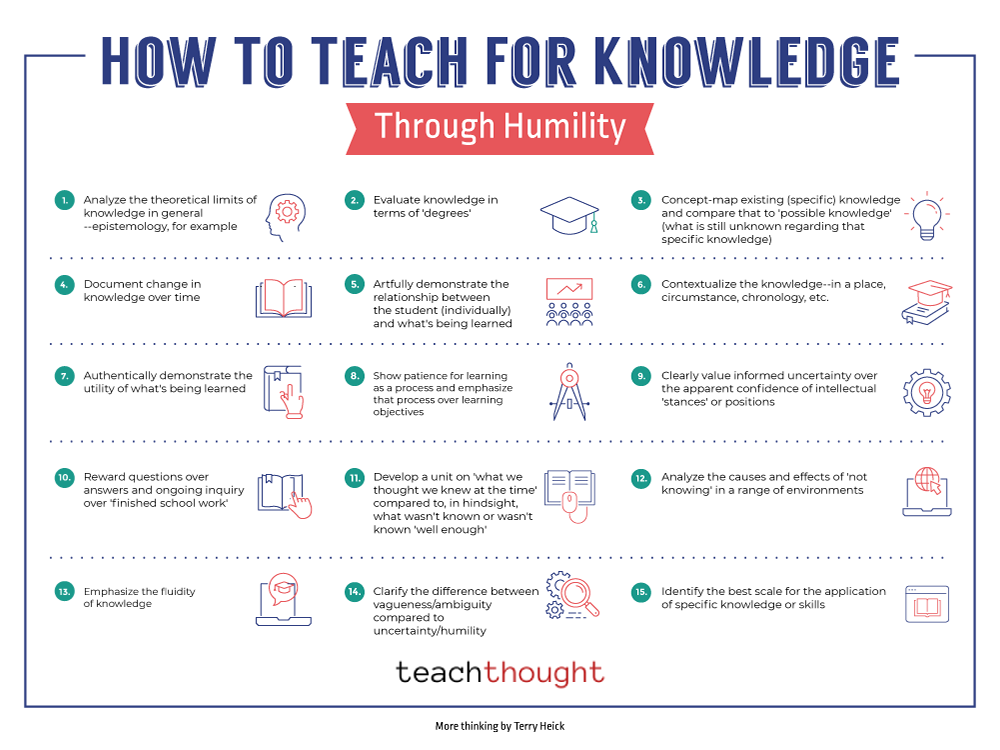
- Analyze the boundaries of information in plain phrases (a easy introduction to epistemology).
- Consider information in levels (e.g., sure, possible, doable, unlikely).
- Idea-map what’s at the moment understood a couple of particular subject and examine it to unanswered questions.
- Doc how information modifications over time (private studying logs and historic snapshots).
- Present how every pupil’s perspective shapes their relationship to what’s being discovered.
- Contextualize information—place, circumstance, chronology, stakeholders.
- Exhibit genuine utility: the place and the way this data is used outdoors college.
- Present persistence for studying as a course of and emphasize that course of alongside aims.
- Clearly worth knowledgeable uncertainty over the arrogance of fast conclusions.
- Reward ongoing questions and follow-up investigations greater than “completed” solutions.
- Create a unit on “what we thought we knew then” versus what hindsight exhibits we missed.
- Analyze causes and results of “not realizing” in science, historical past, civic life, or each day selections.
- Spotlight the fluid, evolving nature of information.
- Differentiate vagueness/ambiguity (lack of readability) from uncertainty/humility (consciousness of limits).
- Determine the most effective scale for making use of particular information or abilities (particular person, native, systemic).
Analysis Be aware
Analysis exhibits that individuals who apply mental humility—being prepared to confess what they don’t know—are extra open to studying and fewer more likely to cling to false certainty.
Supply: Leary, M. R., Diebels, Ok. J., Davisson, E. Ok., et al. (2017). Cognitive and interpersonal options of mental humility. Persona and Social Psychology Bulletin, 43(6), 793–813.
Literary Touchstone
Berry, W. (1969). “A Native Hill,” in The Lengthy-Legged Home. New York: Harcourt.
This concept could appear summary and even misplaced in more and more “research-based” and “data-driven” programs of studying. However that’s a part of its worth: it helps college students see information not as fastened, however as a residing course of they will be a part of with care, proof, and humility.
Instructing For Data, Studying By means of Humility

Trending Merchandise