contributed by Kathy Glass
We frequently ask college students to make use of context clues to determine a phrase’s that means. That makes it our job as academics to explicitly train how authors use them.
In doing so, college students acquire a listing of methods (corresponding to utilizing studying response questions) to unlock the that means of unfamiliar phrases and deepen their general comprehension. With out consciousness of the forms of context clues, college students are at a drawback when making an attempt to find out that means independently.
See additionally 25 Reading Strategies That Work In Every Content Area
Educating this talent helps self-agency, permitting college students to outline unfamiliar phrases on their very own. The next are units that authors use to include context clues into their writing. The purpose isn’t to memorize every kind, however to assist college students perceive that authors present hints in some ways—and readers must be alert to those patterns.
Though the checklist beneath appears neat and categorized, remind college students to learn the whole passage the place an unfamiliar phrase seems. This broader view helps them infer that means and higher perceive the encompassing textual content.
Based on analysis by Beck, McKeown, and Kucan (2002), vocabulary progress relies upon closely on college students studying to derive phrase meanings from context—not simply memorizing definitions.
7 Methods For Utilizing Context Clues
1. Phrase Components
The thought: Break down the phrase into elements—base phrase, prefix, and suffix.
Instance: Discrimination
- Dis-: not, reverse of, reverse
- crimin: verdict, judgment
- -tion: signifies a noun
This breakdown supplies perception into the phrase’s general that means.
2. Definition or Rationalization
The thought: The sentence might comprise a direct rationalization or definition.
Examples:
- Discrimination, or unfairly concentrating on a bunch, may cause misery.
- Weak individuals are usually protected beneath legal guidelines that stop exploitation.
3. Synonym
The thought: Phrases close to the unfamiliar time period would possibly provide a synonym.
Examples:
- Discrimination or bias may cause misery.
- People who find themselves weak or defenseless might keep away from hurt by staying alert.
4. Instance
The thought: Particular examples assist make clear the that means.
Examples:
- Like forcing people who smoke exterior, discrimination targets a perceived undesirable group.
- Weak folks, corresponding to kids or the aged, are sometimes protected by legislation.
5. Antonym or Distinction
The thought: Reverse meanings are sometimes launched with distinction phrases like in contrast to or versus.
Examples:
- Discrimination, versus equity, can have damaging results.
- Weak folks, in contrast to those that can defend themselves, are sometimes targets of hurt.
6. Analogy
The thought: Comparisons provide clues to phrase that means.
Examples:
- Discrimination is like hateful vines wrapping across the coronary heart.
- Weak individuals are like delicate glass—simply damaged, needing care.
7. Appositive
The thought: An appositive renames or defines a noun straight.
Examples:
- Discrimination, the act of displaying bias, may cause hurt.
- The aged and handicapped, a weak group, are protected by legislation.
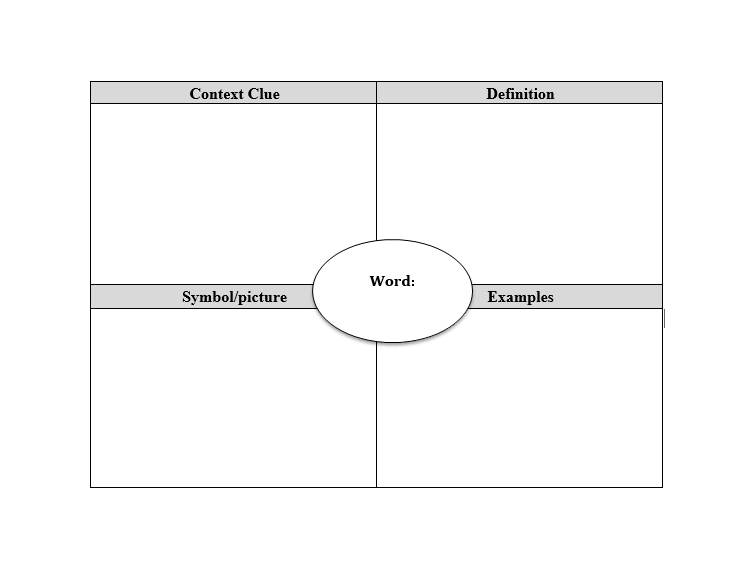
Determine A: 4-Sq. Graphic Organizer
Comply with-Up: Reinforcing New Vocabulary
After figuring out the clue, information college students in internalizing the brand new phrase via observe and inventive use.
Apply Sentences
Determine B: Brief Writing Process Choices
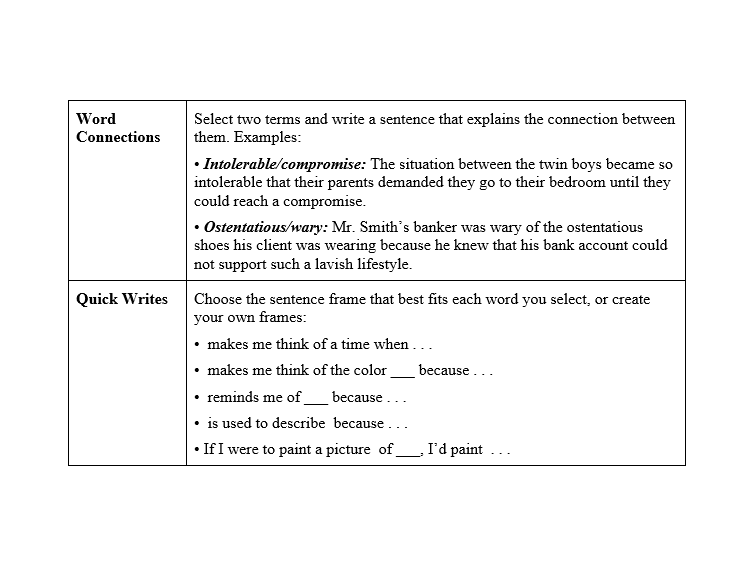
Use vocabulary pairs in context:
- Insupportable/compromise: The scenario between the twins grew to become so insupportable that their dad and mom insisted they attain a compromise.
- Ostentatious/cautious: Mr. Smith’s banker was cautious of the ostentatious footwear, figuring out his shopper couldn’t afford such luxurious.
Fast Writes
Invite college students to mirror on the phrase with sentence stems:
- ___ jogs my memory of a time when…
- ___ makes me consider the colour ___ as a result of…
- If I have been to color an image of ___, I’d paint…
Examples and Non-Examples
For the phrase: Variety
Examples:
- A faculty with college students from a number of cultures
- A office crew from different backgrounds
- A meals courtroom that includes world cuisines
Non-Examples:
- An all-women’s faculty
- A management crew of 1 race or gender
- Segregated faculties earlier than civil rights reform
Conclusion: Serving to College students Assist Themselves
Authors don’t all the time present context clues—typically they assume the reader already is aware of the phrase. However when clues are current, equipping college students to acknowledge and use them improves comprehension and helps unbiased studying progress.
Educating college students learn how to “learn across the phrase” empowers them to assume critically, learn deeply, and study frequently.
Tailored from Advanced Textual content Decoded: The way to Design Classes and Use Methods That Goal Genuine Texts by Kathy T. Glass (ASCD, 2015).
Kathy Glass consults nationally with faculties and districts, presents at conferences, and teaches seminars for college and county applications delivering personalized skilled growth. A former grasp instructor, she has been in training for greater than 25 years and works with directors and academics in teams of various sizes from kindergarten via highschool. She is the writer of Advanced Textual content Decoded: The way to Design Classes and Use Methods That Goal Genuine Texts. Join with Kathy via her web site, www.kathyglassconsulting.com.
Trending Merchandise